
Wrestling Match Types Explained
A stipulation changes the whole story of a match. Some add weapons, some remove the pinfall, and some lock everyone inside a structure. Here is how each common type is won, with the earliest known example where a reliable record exists.
Several of these formats are best known under one promotion's branded name. We name them factually for clarity; this site is not connected to any promotion.
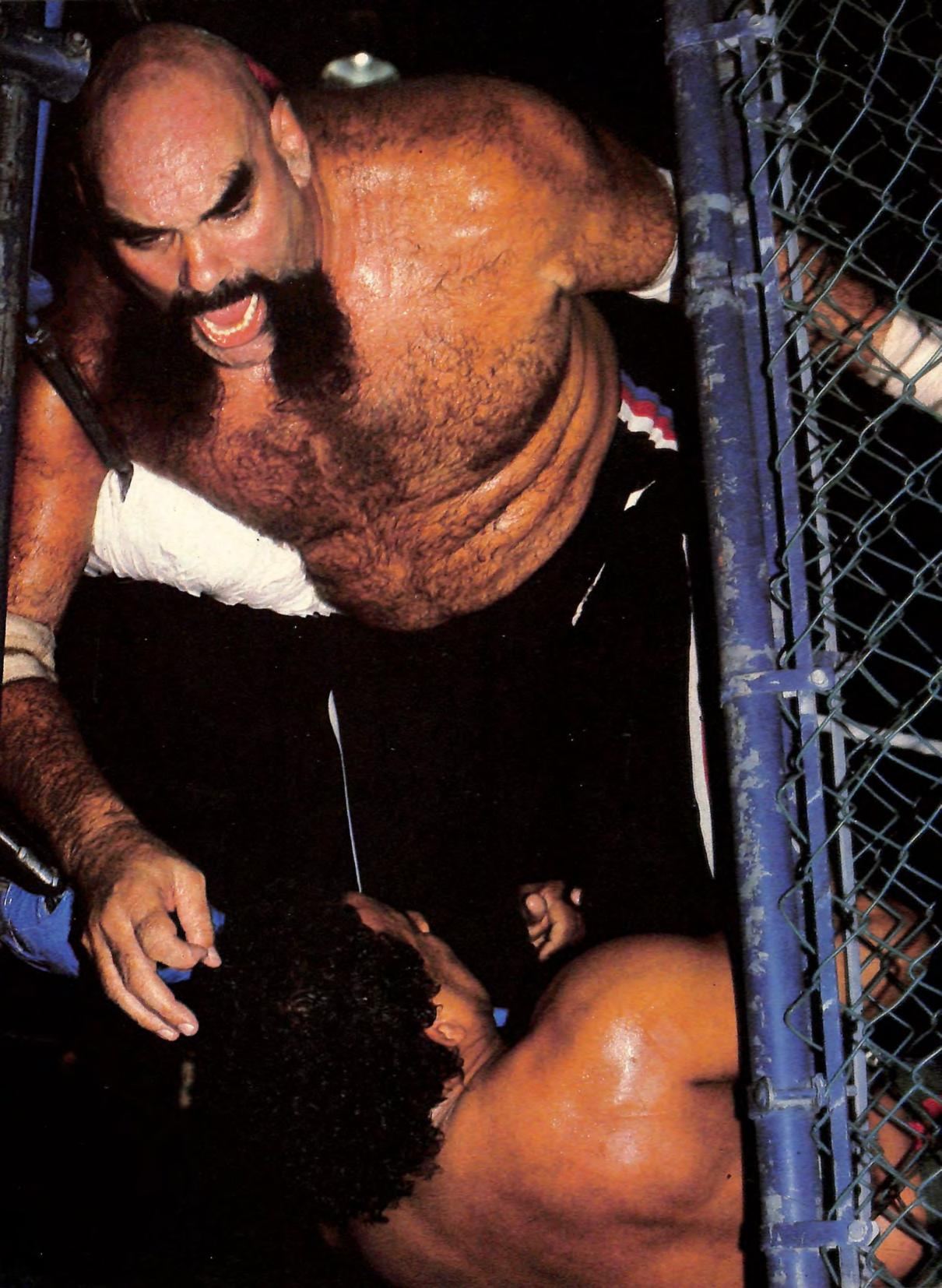
Ox Baker and Jose Gonzalez in a steel cage, around 1983: Unknown author, Public domain
Steel cage match
The ring is surrounded by mesh walls. Most often you win by escaping, over the top or through the door, with both feet touching the floor, though some cage matches also allow pinfalls and submissions. In Mexico, reaching the top of the wall is usually enough. Deep dive at /steel-cage-match/.
- Win by
- Escape, sometimes pin or submission
- Earliest known
- January 9, 1936, Caruthersville, Missouri (chicken wire)
Hell in a Cell
A roofed chain-link cell covers the ring and the ringside area. There are no disqualifications, and normally only a pinfall or submission inside the ring ends it. The locked door is the only legal exit.
- Win by
- Pinfall or submission in the ring
- First
- October 5, 1997, Shawn Michaels vs The Undertaker
Elimination Chamber
Six wrestlers, a steel structure and four glass pods. Two start in the ring and the others are released at set intervals. Eliminations come by pinfall or submission until one remains.
- Win by
- Last one left after pins and submissions
- First
- November 17, 2002, won by Shawn Michaels
Ladder match
A prize such as a title belt or a briefcase hangs above the ring. The first wrestler to climb a ladder and pull it down wins.
- Win by
- Retrieving the hanging item
- First known
- September 1972, Stampede Wrestling, Dan Kroffat vs Tor Kamata
Tables match
You win by driving your opponent through a table with an offensive move. Many tables matches also drop disqualifications, which turns them into full hardcore bouts.
- Win by
- Putting the opponent through a table
- First known
- 1995, an ECW tag team title match
Tables, ladders and chairs (TLC)
All three items are legal weapons. In the standard version a prize hangs above the ring and the winner climbs to grab it, though some versions are decided by pinfall or submission instead.
- Win by
- Retrieving the prize (usual version)
- First
- August 27, 2000, a three-way tag team match
Battle royal
Usually 20 or more wrestlers start in the ring together. You are out when you go over the top rope and both feet touch the floor. The last one left wins.
- Win by
- Being the last wrestler in the ring
Timed-entry battle royal (Rumble rules)
Two wrestlers start and the rest enter one at a time, usually every 90 seconds or two minutes. Elimination still requires going over the top rope with both feet on the floor. Pat Patterson is credited with creating the format.
- Win by
- Last one left
- First televised
- January 24, 1988, won by Jim Duggan
Iron man match
A set time limit, often 30 or 60 minutes. Every pinfall or submission counts, and whoever has more falls when time runs out wins. Ties can go to sudden-death overtime.
- Win by
- Most falls when time expires
- Famous example
- WrestleMania XII, 1996, 60 minutes plus overtime
Submission match
Pinfalls, count-outs and disqualifications do not count. The only way to win is to make your opponent tap out to a hold.
- Win by
- Submission only
I Quit match
A submission match with a twist: your opponent has to say the words into a microphone held by the referee. A tap is not enough.
- Win by
- Opponent says I quit
Last man standing
No pinfalls, submissions, count-outs or disqualifications. It works like a boxing knockout: a downed wrestler who cannot get to their feet before the referee counts to ten loses. Its older cousin, the Texas death match, adds falls and rest periods.
- Win by
- Opponent fails to stand by a 10 count
Hardcore match
No disqualifications, no count-outs and falls count anywhere. Weapons are legal and the only rule is to pin or submit your opponent. The style grew in Japan in the 1970s and in the US in the 1990s.
- Win by
- Pinfall or submission anywhere
Falls count anywhere
A pinfall can happen anywhere in the building, not only in the ring, so these matches often roam backstage or into the crowd. They are always no disqualification and no count-out.
- Win by
- Pinfall (sometimes submission) anywhere
Tag team match
Only one wrestler per team is legal in the ring at a time. To swap, the outside partner, standing on the apron, makes a tag the referee can see. A pinfall or submission on the legal opponent wins it.
- Win by
- Pin or submit the legal opponent
Lucha libre trios
Mexican lucha libre favors three-person teams, often with a captain. A fall comes from pinning the captain or both other members, and many lucha bouts are two out of three falls. More at /lucha-libre-and-the-mask/.
- Win by
- Pin the captain or both partners, often best of three falls
Match names such as Hell in a Cell, Elimination Chamber and Royal Rumble are trademarks of their owners and appear here only to describe the history. This site is independent and not affiliated with any promotion.
- Wikipedia: Professional wrestling match types
- Wikipedia: Hell in a Cell
- Wikipedia: Elimination Chamber
- Wikipedia: Ladder match
- Wikipedia: Tables, Ladders, and Chairs match
- Wikipedia: Battle royal (professional wrestling)
- Wikipedia: Royal Rumble match
- Wikipedia: Iron man match
- Wikipedia: I Quit match
- Wikipedia: Hardcore wrestling
- Wikipedia: Tag team
- Wikipedia: Lucha libre
Facts on this page were checked against these sources (updated Oct 1, 2026). Spot an error? Email hello@fireempireshop.com.